

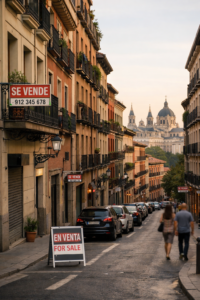
Spain’s hottest urban markets are showing the first real signs of cooling after years of relentless price growth. Fresh Q1‑2026 data from Idealista reveals a sharp rise in listings in the country’s major cities — a shift that contrasts strongly with the national trend of shrinking supply. Madrid leads the surge with a 17% year‑on‑year increase in homes for sale, followed by Valencia (+13%), Barcelona (+6%), Sevilla (+5%), and Málaga (+3%).
But more listings do not mean a flood of new properties hitting the market. In reality, it’s a symptom of something deeper: homes are taking longer to sell because buyers are hitting their affordability limits.
What’s Really Happening?
The rise in supply in these cities is happening despite the fact that, nationally, the number of homes for sale actually fell by 10% year‑on‑year.
This divergence signals a market moving at two speeds:
- Big cities: Prices have climbed so high that demand is starting to weaken.
- Rest of Spain: Supply remains tight, and demand is still strong.
Idealista’s analysts put it bluntly: prices in cities like Madrid and Barcelona have become “unreachable” for a significant portion of buyers.
Prices Are Still Rising — And Fast
The Registradores’ official Q1‑2026 report confirms the same underlying pressure:
- Spain’s average price hit a record €2,429/m², up 3.2% in a single quarter.
- Madrid reached €4,407/m², the highest in the country.
- Málaga hit €3,339/m², also a historic high.
This aligns with the surge in listings: when prices rise faster than incomes — and mortgage costs remain elevated — even motivated buyers start stepping back.
Why More Homes Are Sitting on the Market
Based on the data and market logic, several forces are converging:
- Buyers are reaching their financial limit
Mortgage costs remain high, and the Registradores report shows the average monthly mortgage payment rising to €807.8, with affordability worsening nationwide.
- Sellers are slow to adjust expectations
After years of double‑digit growth, many sellers still price homes as if demand were infinite. But buyers are now more cautious — especially in Madrid, Barcelona, and Málaga, where prices have surged the most.
- Homes take longer to sell → supply appears to rise
This is the key point: The increase in listings is not new supply — it’s old supply that isn’t moving.
- Foreign demand remains strong but not enough to absorb everything
International buyers still represent 13.9% of purchases, with hotspots like Alicante at 44.7%. But even this strong segment is not offsetting affordability pressures in the biggest cities.
Are We Heading Toward a Price Correction?
Not necessarily — but a rebalancing is underway.
Idealista suggests that reduced buyer pressure could help stabilise prices in overheated markets. Registradores data supports this: despite record prices, sales volumes dipped slightly (-0.1% quarterly), hinting at a turning point.
However, a crash is unlikely because:
- Spain still suffers from structural housing shortages in major cities.
- New‑build supply remains extremely limited.
- Population growth and foreign demand continue to support the market.
The more probable scenario is slower price growth, longer selling times, and a shift toward a more balanced market.
For more information on buying property in Marbella and Costa del Sol, visit Nookhomes for expert guidance and listings that meet your criteria.
Let us help you find your dream home: